

Painters have carried a palette for centuries, and it still says "artist" faster than any brush or easel. But a palette pin is a lot smaller than a studio tool, so what does it actually tell people?
This article unpacks what the palette motif says about painting, creativity and self-expression, and how wearing it turns into a creative accessory.
The meaning of a paint palette pin starts with the painter’s trade
Painters have used palettes in their studios for ages, so it became a sign of painting and of the trade. Nobody needs a caption for it.
In portraits, painters often held one to show their job. William Hogarth put a palette in The Painter and his Pug (1745) as part of his statement about his professional aims.
Skip the easel: the palette says painter faster than anything else.
A traditional palette is a flat board with a thumbhole, so the painter can hold it while mixing paint. An enamel pin is a small metal badge with colored enamel set into its surface, which means the same object fits on a jacket, hat or bag. Want brushes and paint banners too? For a busier design, see the Create More Worry Less palette pin.
Why a palette stands for process as much as finished art
The palette is where the real work happens. Painters set raw colors along the top, then mixed them farther down before a stroke reached the canvas.
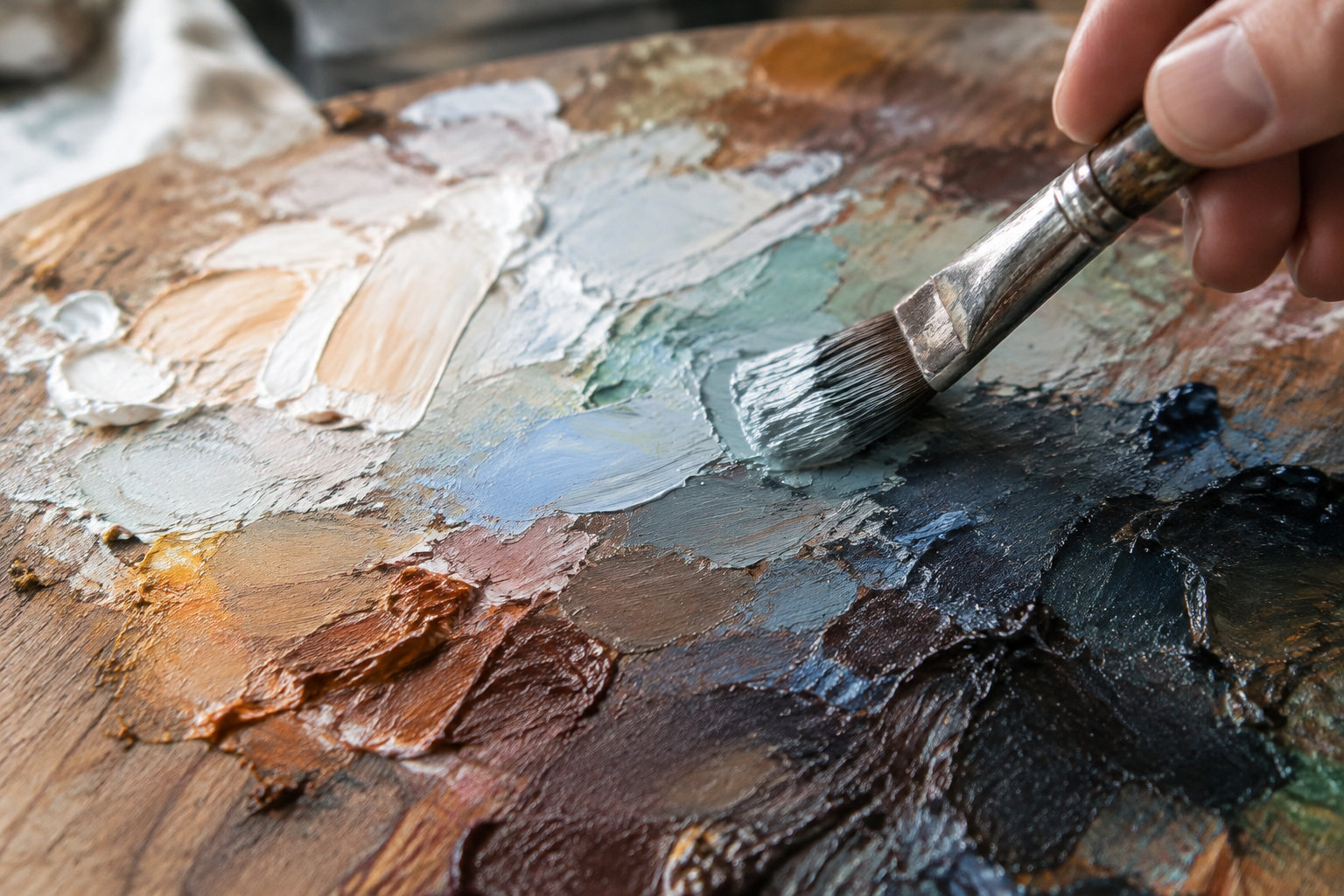
In 18th-century studios, those mixes supplied the tones and shades each artwork needed. Pick a palette pin that shows the mixing, not just the finished picture.
Painters never used the same palette. Jean-François Vien kept seven main colors, while Joseph Vernet preferred eleven. So a palette can show you:
- Which paints were used and how they were arranged, from light to dark.
- Which colors were mixed together.
- Which medium, such as linseed oil, was mixed in.
What the pin hints at
Testing
- Colors tried out before the picture
- Mixes worked out on the surface
Hidden choices
- Shades picked before the first stroke
- Whistler set out his colors before painting
Saved paint
- Old palettes show materials and methods
- Denim jacket? See best pins for denim jackets
Can a palette really say that someone is an artist?
Painters have long used the palette to say what they do. Vigée-Lebrun held one in her 1782 Self-Portrait in a Straw Hat, even though she sits outdoors. The palette alone says she paints.
Mary Beale did it too, with a palette on the wall behind her and her sons.
Even a man in a 1650 Italian portrait gets read as a painter just for holding one. Honestly, it’s the bluntest way to say you paint, and that’s the point.
Holding a palette vs wearing one
In a portrait
The palette sits inside a scene the painter built on purpose. When the sitter holds it, the viewer reads their job straight away.
On a pin
The palette is a tiny object on your jacket. It shows you’re into art, but it can’t show whether you paint on weekends or never touch a brush.
What wearing the motif communicates on a jacket, hat or bag
Stick it on a hat, a jacket or a bag, and it turns into a sign anyone can read. Put it where people look first, like the collar or the brim, not buried at the bottom of a tote.
Start with a bag: it’s the easiest spot to see, and the easiest to change.
Three messages a pin can send:
- A FriendsWithYou character shows you like art without any painter’s tool in the design.
- A Van Gogh Irises pin turns the painting itself into something you wear.
- Custom badges show individuality and belonging, the way Finnish students did with patches on their clothes.
Your reason makes the pin
-
You paint
The palette tells people you mix colours yourself.
-
You love art without painting
It shows interest, even with no brush at home.
-
You just like the look
Honestly, a cool design is reason enough, and it’s still your reason.
How color and design change what the palette pin says
Bright colours make the pin loud and cheerful, so the fun comes first. A plain outline puts the palette shape in front. Raised metal details make it look like a real working tool.
Whatever the design, the thumbhole and paint marks do the real work, so don’t pick a version that hides them.
Adding a brush or paint tubes makes the painting link more direct. Van Gogh’s Irises pin goes further and points to one particular artwork.
| Criteria | Plain palette | With brush or tubes | Irises pin |
|---|---|---|---|
| Link to painting | General | Direct | Direct |
| Link to one artwork | None | None | Specific |
Colour changes how the pin looks, but no shade comes with a fixed meaning. Is green calm or jealous? Nobody agrees, so pick the one that matches how you want to come across.
Choosing a palette pin that matches your creative side
Three levels to choose from. A plain palette says you love creating. Add a brush and paint tubes, and it says you paint.
Tie it to one painter or one canvas, and you’re showing off your art history, which is a bolder claim. Go for the brush-and-tubes version if you actually paint.
Match the pin to the wearer and the spot:
- Plain palette: anyone who makes things. Wear it on a backpack.
- Irises: fans of its blue colors and brush marks. Try a shirt or handbag.
- Van Gogh self-portrait: serious fans only. Pin it to a hat.
Check the size first
- Measure the spot where you’ll wear it, in inches or mm.
- Compare it with the pin: Art Institute of Chicago pins run 1.25 to 1.75 inches (32 to 44 mm).
- Choose the 1-inch (25 mm) Van Gogh pin for narrow spots.
- Test the fit with a ruler before buying.
A palette pin says you care about art. If you paint, choose the brush and tubes version. If you just love the look, a plain palette is reason enough.
Your next step is to measure the spot you have in mind and check the size before you buy. Once it fits, pin it where people look first.
Frequently asked questions
What is the meaning of a color palette?
A color palette is the surface a painter uses to lay out and mix paint. As a symbol, it stands for painting and the painter.
Worn on a pin, it also says you’re into art or creative work, even if you never touch a brush.
Do paint palette pins only appeal to painters?
No, you don’t have to be a painter to wear one. The palette stands for painting, art and creative work in general, so the pin shows you’re into those things. Love galleries? Like making stuff? That’s reason enough.
Where is a paint palette pin usually worn?
A paint palette pin usually goes on a jacket, hat, shirt, backpack, handbag or another bag. Any of those spots works, so take your pick and move it whenever your outfit changes.
Is a paint palette pin a good gift for an artist?
Yes, a palette pin makes a good gift for an artist or any creative person. Pick the design with a watercolor brush and paint tubes next to the palette, since it shows what they actually do.
0 comentarios