

Plenty of travelers stick pins in a map and forget what the colors were meant to show. A pin on a globe can mark a trip already taken or a dream still waiting.
So what does a globe pin actually stand for? This article explains what it signals for modern explorers, from places visited to journeys planned.
The meaning of a globe pin: the whole world, one marked place at a time
A globe pin is the whole world with one spot singled out. The globe shows every continent; the pin says this place matters.
Nobody issued an official rulebook, so this is an interpretation, not a fixed meaning.
For travelers, the pin usually marks a place visited or still on the list. Point it at your next trip and let the globe do the rest.
Look for the legend first. A red pin might mean visited and a blue one planned, but that’s only if the map says so. Then ask yourself what you wanted the pin to do. A dream spot and a finished trip can look exactly the same on the map.
What the globe adds: a whole-world view that flat maps distort
Natural and political features on a globe
On a globe, you get everything at once. Deserts, mountains, rivers, lakes and oceans sit beside countries, states and cities. That mix is what makes a journey easy to picture.
Trace a line from one city, over a mountain range, across a desert. Your finger does the trip, and the borders show which countries you’d cross. Pretty handy, and way more fun than scrolling.
Why a globe shows shapes and sizes more faithfully
A globe keeps shapes and sizes close to the truth. Its round surface matches Earth’s, so land looks about as big as it really is.
A flat map has to stretch that curve onto a page. Every flat map distorts at least one thing: area, shape, distance or direction. Comparing country sizes? Skip the flat map and use a globe.
Mercator vs. globe
Mercator map
- Greenland can look close to Africa’s size.
- Angles stay right, so it works well for navigation.
- Land near the poles looks bigger than it really is.
Globe
- Greenland looks small next to Africa.
- Africa is about 14 times larger.
- Land near the poles keeps its real size.
The pin marks one spot, not the whole trip
A pin marks one spot. It doesn’t draw the road to the next one. So a single pin can find a place, share it, or start and end a route, but it never shows the whole trip.
Staring at a map full of pins? Don’t guess the route. Look for lines or notes, since a lone pin proves very little.
Here’s the iPhone routine in Apple Maps:
- Touch and hold the map until a pin appears.
- Tap Move, drag the map to line up the spot, then tap Pin to keep it.
- Tap the pin, then the directions button, to get a route there.
- Tap the share control at the top of the card and choose how to send it.
How do explorers use globe pins to record and plan trips?
Push-pin world maps as travel records
A push-pin travel map is the low-tech way to track your trips. Each pin is a place you have visited or one you still plan to see.
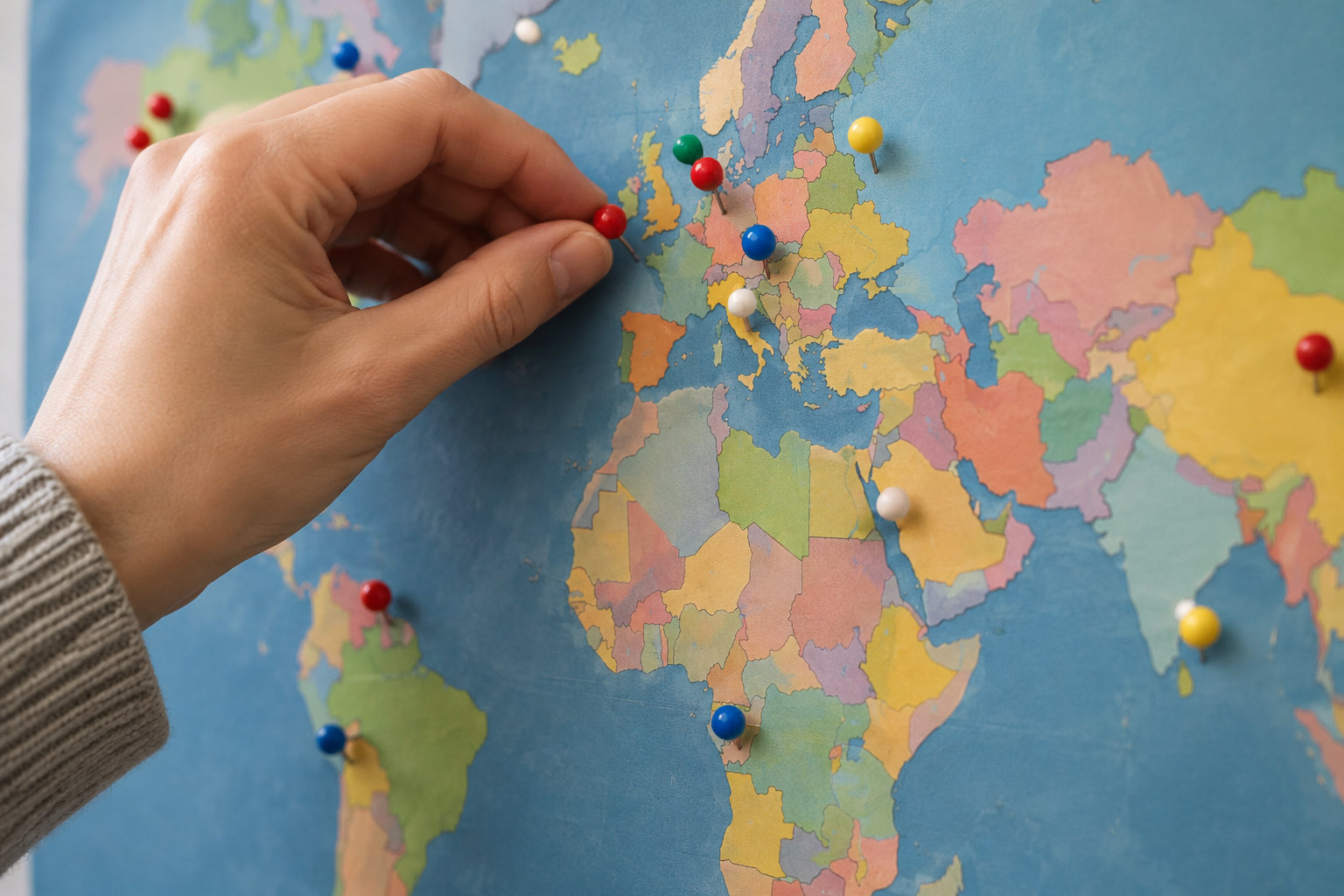
Most people use one color for places visited, another for planned trips, and a third for dream destinations. Write that key on the map’s edge, or a month later you’ll forget which color means what.
Same pins, different keys
-
Visited vs. bucket list
A 30-by-45-inch map holds 150 pins in three colors. One color marks visited places, another bucket-list spots.
-
One color per person
Give each traveler a color to see who went where.
-
Lived, worked, visited
One color for home, one for work, one for visits.
-
Named labels
Labels like "Places Visited" and "Dream Vacations" tell each color its job.
Pins that trace routes, not just places
Some maps go further than dots. A GeoJango map, 40 by 28 inches with 500 pins in eight colors, can use pins to trace a cruise, a hiking trail or a train route.
Big and small pins can separate kinds of destinations.
The pins only show what you assign to them, so check the key first. For any trip where the order of stops matters, trace the line, because loose pins hide the order.
Digital pins: planning and recording trips in an app
Saving and routing pins in Apple Maps
Dropping a pin is easy. Keeping it is the part people skip. In Apple Maps, save each dropped pin to Places if you want to keep several. Saved pins appear as icons in Places.
Skip this and you’ll re-drop the same spots from memory, which is a fine way to lose a good trip. Save every pin you care about now, while you still remember why it’s there.
Once it’s saved, a pin is good for four things, and each one takes only a few taps:
- Find it: open Places and tap Pinned to see every saved pin.
- Route to it: tap the pin, then the directions button.
- Use it as a route endpoint: a dropped pin can be the start or the end of a route.
- Share it: swipe left on the pin, then tap Share.
Pin Traveler: colors, notes and travel statistics
What Pin Traveler offers
Pins
- Mark cities, countries, locations and U.S. states
- Add photos to visits and locations
Trips
- Add trip dates to your pins
- View visits in time order
- Use colors to sort trips, wish lists and custom lists
Statistics
- See your farthest trip
- See your most-visited places
Sharing
- Share stops with fellow travelers
- Add photos and record memories together
Why the legend, not the pin, tells you where a trip stands
A pin on its own doesn’t tell you if a place is visited or planned. On one travel map, red, white and black pins can mean past trips, future trips and favorite places.
Another map may use colors to show who went there, or whether someone lived or worked there. Before you read any pin, check the key first, because a pin without one is just a guess.
Before you read a pin
- Find the map key or legend and note what each pin color means.
- In a travel app, check the labels, such as "visited" or "wish list".
- Ask yourself whether you actually took the trip or only plan to take it.
- Write the meaning of each color down once, so you read every pin the same way.
A globe pin means what its map says it means. For travelers, it usually marks a place visited or still on the list, but only the key tells you which.
Next step: open your map, find the legend, and write down what each color stands for. Then drop your next pin and decide if it’s a trip taken or a dream.
Frequently asked questions
What do pins symbolize in general?
A pin marks one location on a map. On a travel map, it usually stands for a place you’ve visited or one you still plan to see.
Add a globe and the pin points to a spot somewhere in the wider world.
What is the meaning of the word globe?
A globe is a round model of Earth. You can spin it with one hand and see the whole planet in seconds, which is why explorers have loved them for centuries. Simple idea, and it still works.
Is a globe pin the same as a map pin?
Not quite. A map pin marks one location, and a globe pin adds a globe to that marker, so it points to a place somewhere in the wider world. The pin still marks one spot, now on the whole planet.
0 commenti